

Headless CMS
What Sanity CMS is, and when it beats WordPress
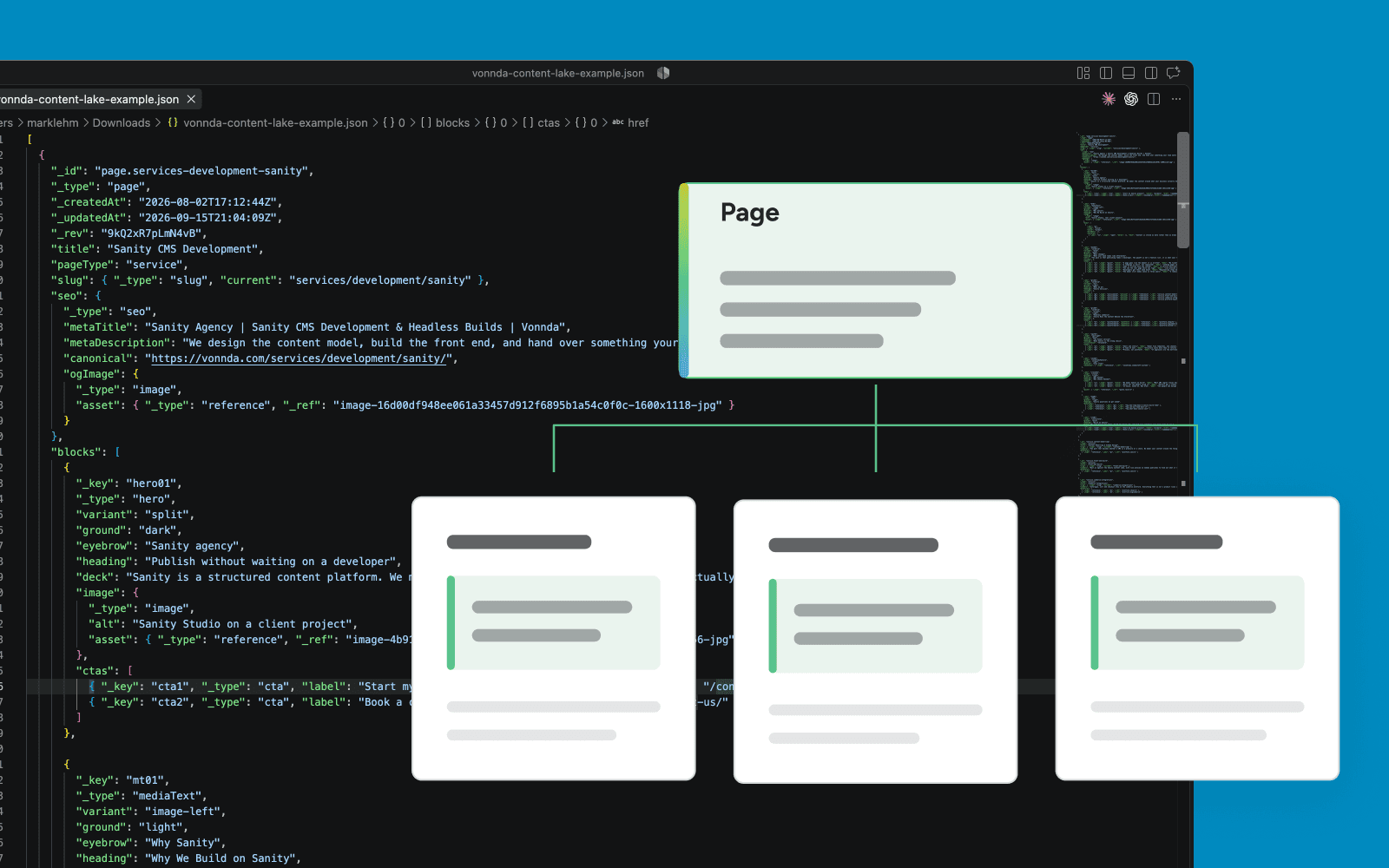
Sanity is a headless CMS: it stores your content as structured data and hands it to whatever front end you build, instead of storing pages. That distinction sounds academic until the third time someone asks a developer to publish a blog post.
We run our own site on it, so what follows is from operating the thing rather than from a vendor deck.
The short version
Content as data, not as pages
A traditional CMS stores a page. The headline, the image, the three paragraphs and the layout live together in one record, and the only thing that record knows how to be is that page.
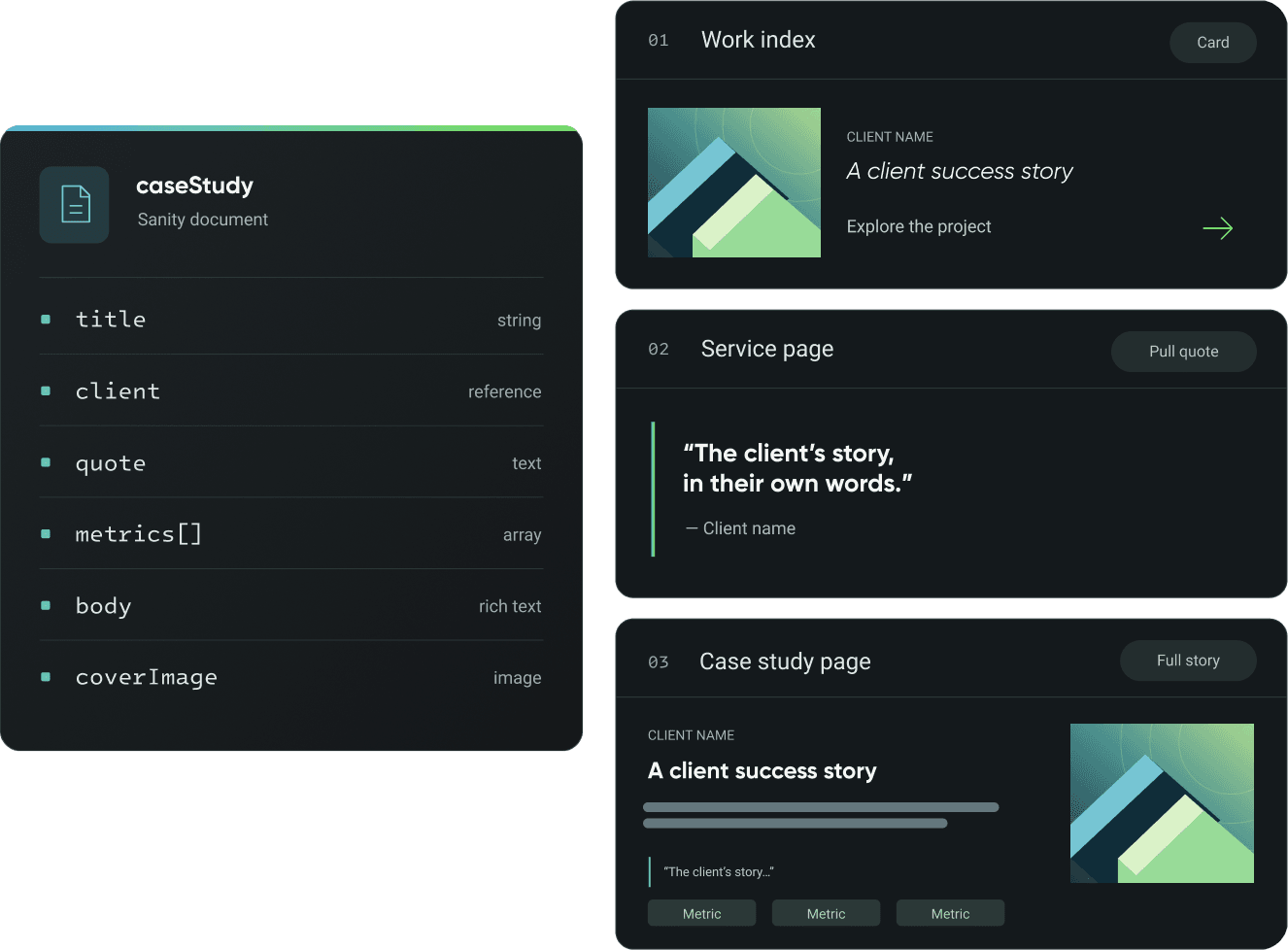
Sanity stores the pieces. A case study is a client, a challenge, an outcome and a set of figures. Where those pieces appear, and what they look like, is the front end's problem. That is the whole idea and everything else follows from it.
The practical consequence: the same client quote can appear on a case study, a service page and the homepage, written once. Change it in one place and it changes everywhere, because there was only ever one copy of it.
What changes
What a week looks like once it is in place
A page goes live the moment it is written
No ticket, no release, no waiting for someone else's deploy window. The person who wrote it publishes it.
A campaign is built, not requested
Landing pages come out of the same blocks the rest of the site uses, so marketing assembles one in an afternoon rather than briefing it.
Copy is written once and reused
A service description, a client quote, a set of figures: written in one place and pulled in wherever it is needed, so there is no third copy to go stale.
You see the real page while you type
Live preview against the actual front end, not an approximation of it, so nobody publishes to find out what it looks like.
Developers get their week back
Engineering stops being a content bottleneck and goes back to the things only engineering can do.
The model still makes sense in three years
Content shaped around what the business actually has rather than around the pages it happens to have today, so a redesign is a front-end job.
The comparison
Sanity or WordPress
WordPress is the right answer when
You are publishing articles and pages, one website, one team, and the ecosystem is doing real work for you. A blog, a brochure site, a small shop on WooCommerce. Nothing about Sanity beats a well-run WordPress install at being a website.
Sanity is the right answer when
The same content has to appear in more than one place, or more than one channel, or in a shape that is not a page. Products, locations, events, case studies, anything with fields. The moment you are maintaining the same paragraph in three templates, the model is the problem and Sanity is the fix.
The migration between them
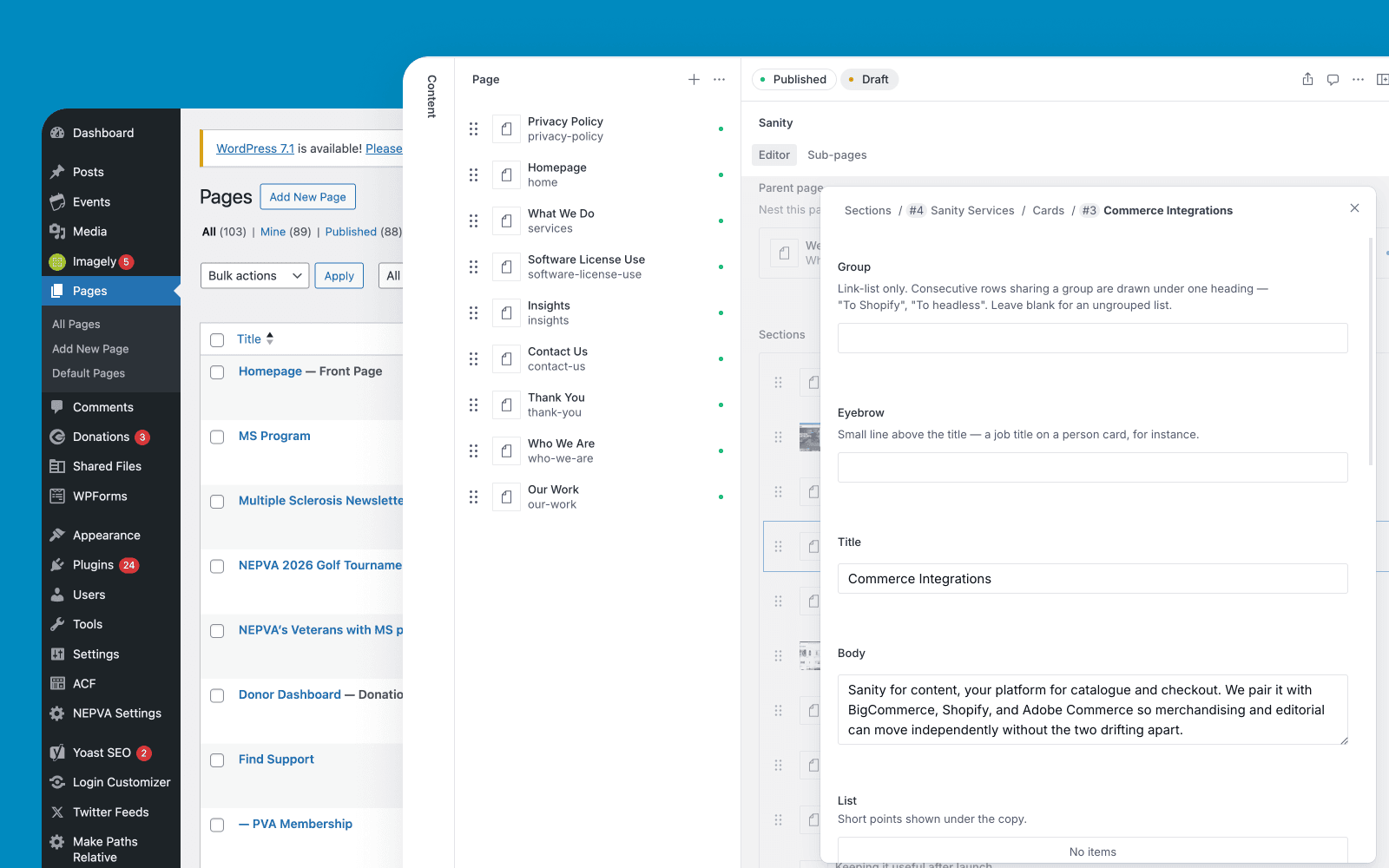
Most of our Sanity work starts as a move off WordPress. Plugin sprawl and page-builder markup get untangled into real content, URLs and SEO stay intact, and the migration is scripted so it can be run and re-run rather than hand-copied.
WordPress to Sanity migrations
The honest version
When Sanity is the wrong choice
Structure costs something up front. Somebody has to decide what a case study is before anyone can write one, and on a small site that decision is pure overhead. If one person publishes a handful of pages on one channel, a page builder is fine and we will tell you so.
It stops being fine when the content types multiply, when a second channel appears, or when a team starts publishing weekly. That is the threshold, and it is worth knowing which side of it you are on before anyone quotes you for a rebuild.
Cost
What Sanity actually costs
The free tier
Free forever, and genuinely usable for a small site, which is unusual in this category: up to 20 user seats, 10,000 documents, two public datasets, and 100GB of bandwidth. Checked against sanity.io/pricing on 23 September 2026.
The paid tier
Growth is $15 per seat per month and raises the ceilings rather than unlocking the basics: up to 50 seats, 25,000 documents, private datasets, and overage you pay as you go. Enterprise is custom, and is about roles, audit and support rather than capacity. Checked against sanity.io/pricing on 23 September 2026.
What drives the build cost
Not the licence. The number of content types, whether the old content is structured or trapped in page-builder markup, and how many integrations sit behind it.
Straight answer
So, is it a good CMS?
The editing experience is the point
The studio is configurable to the point of being a small application. Done well, editors get fields that match their work. Done badly, they get a generic form and hate it. This is where the agency matters more than the platform.
The model is the whole ballgame
Almost every complaint about a CMS traces back to a content model designed page by page. Sanity does not save you from that. It makes a good model pay off more.
It expects a front end
There is no theme to install. You are building a front end, usually in Next.js. A feature if you wanted control, a cost if you wanted to be live on Friday.
Thinking about Sanity for a real project?
Tell us what you are on now and what is breaking. We will tell you honestly whether Sanity fixes it, including when the answer is that it does not.